
Prize Money In Show Jumping
Prize Money In Show Jumping
The most common question I get from my non-horse friends is about how the money works in horse sport. Money In Horse Sport could ultimately be a 12-episode series, as many equestrian businesses profit from multiple forms of high-stakes gambling- not to mention the utter lack of financial transparency in the industry… But for now we’ll just cover the basics of horse show prize money.
Preface: Money isn’t the sole point of competition - There are many ways to profit in the equestrian industry and winning in competition is the most difficult and least reliable. Owning and maintaining horses is extremely expensive, but riders mainly compete for the love of the game. At horse shows, riders are generally trying to win, but they may have other objectives, such as to develop young horses, build confidence, win points of national or world rankings, and sometimes just to train/practice with the horses in a competition format / venue. It’s not always full gas riding for prize money.
Horse Show Fees and Prize Money
How do you make money in competitions (aka, at horse shows)?
In order to compete at a show, riders must pay “entry fees” to the competition venue. Basically, the more difficult classes you jump, the more expensive the entry fees are. If you jump a low-level amateur class, you might be paying a couple hundred dollars for a typical show. If you’re jumping international-level grand prix classes, you could be paying a few thousand dollars per show (in the USA, at least).
There are added expenses at competitions as well - if your’e not close to home, you need hotel/housing for yourself and your team and transportation expenses (diesel for the trailer, or commercial shipping if you don’t haul yourself, car rental if necessary).
That might seem like an insane investment to go run around a big sandbox with a horse, but generally, for professionals, you’re aiming to leave a horse show with a net profit.
When you jump Grand Prix competitions in the USA, the minimum amount of prize money awarded to the competitors is $25,000 for National level , and $32,000 for International level shows. Many shows will have 2-5 classes per week offering over $25,000 of prize money, and at the highest level shows there are single classes with up to to $3,000,000 prize money! So, despite having to pay to play, the potential for profit is always there.
This high risk and high reward competition system is partially what makes the sport so addictive. If you have a great week and win a lot you feel like a genius; if you have a bad week and end up losing money you might feel like an irresponsible leech. (This is why sports psychologists make so much money- ha.)
Prize Money Distribution Within The Competition
The prize money is generally distributed to the top 12 placed rider/horse combinations in the classes with either 25% or 30% of the money being awarded to the winner, and decreasingly less awarded to the remaining placing riders.
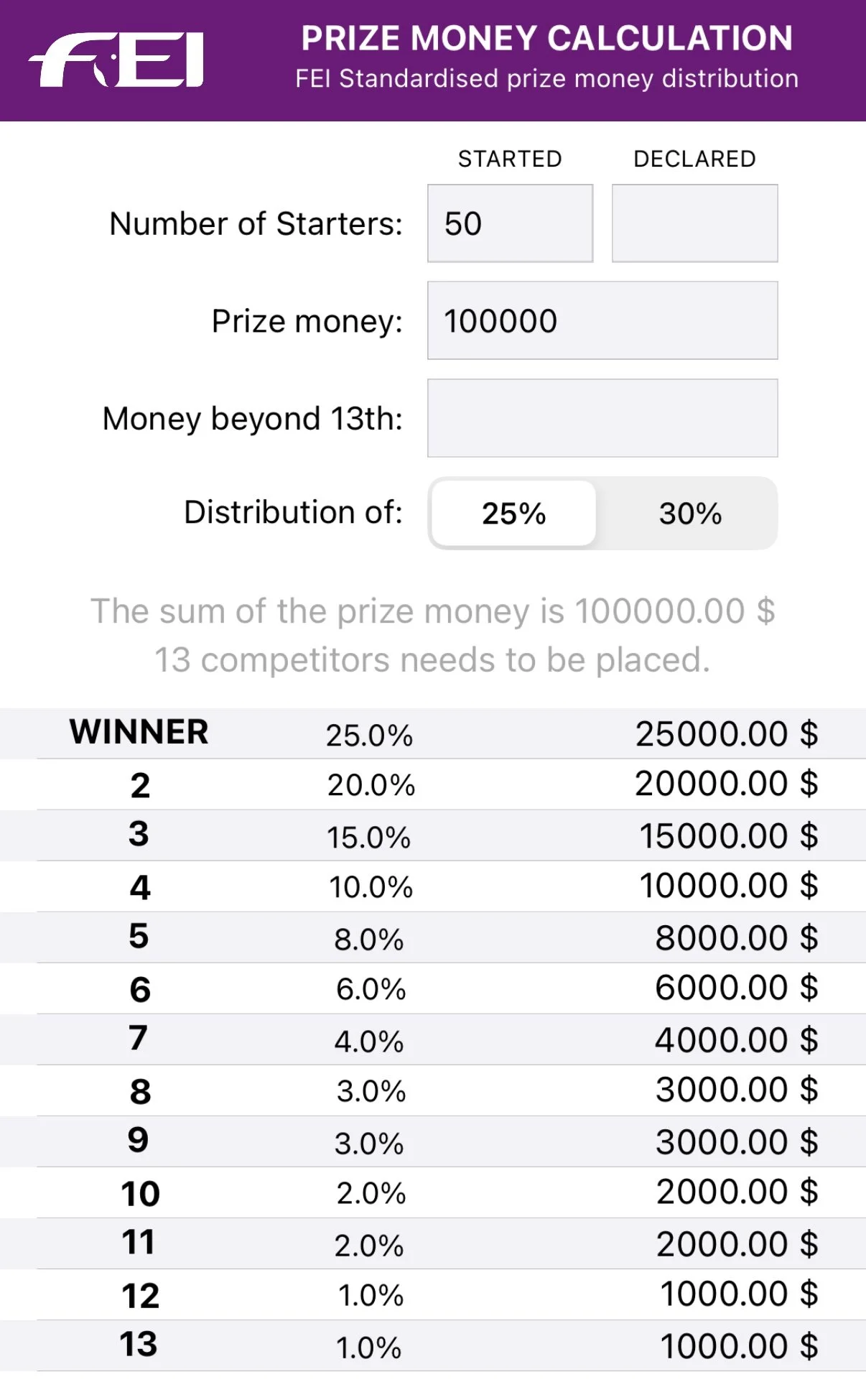
In classes where 25% of the total money is awarded to the winner, 20% goes to 2nd place, 15% to 3rd place, 10% to 4th place, 8% to 5th place, 6% to 6th place, 4% to 7th place, 3% to 8th place, 3% to 9th place, 2% to 10th place, 2% to 11th place, 1% to 12th place, and 1% to 13th place.
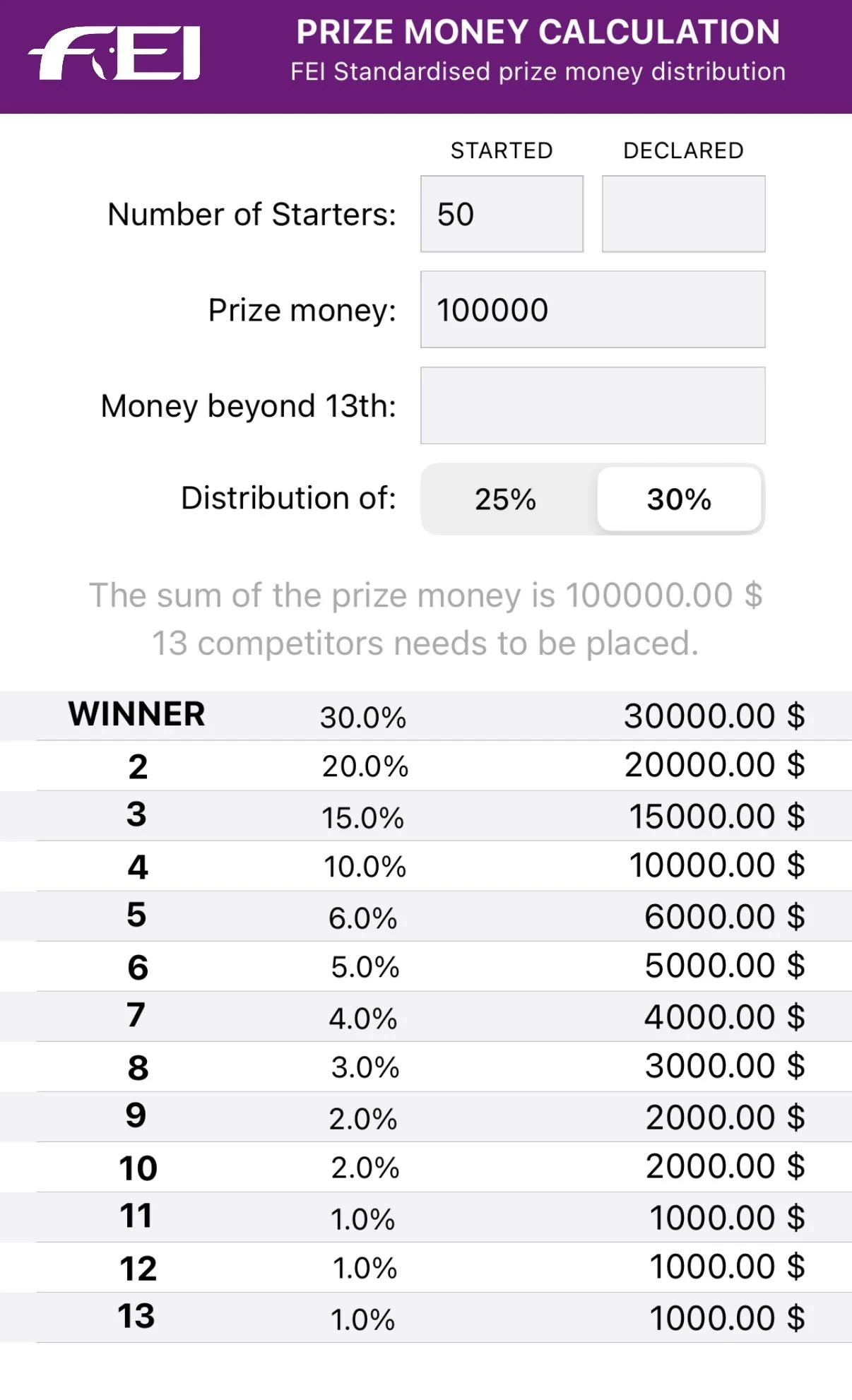
In classes where 30% the total money is awarded to the winner, the distribution is mostly the same except that 5th-13th place each get 1-2 less % points.
What this looks like for a $100,000 class would be:
Miscellaneous:
In international competition, in ranking classes (classes that count for world ranking points and have a minimum prize money of $32,000) it’s normal to pay up to 13th place. If there are over 60 riders in a class sometimes they will distribute money past 13th.
In smaller classes with less prize money, a class may only pay though 8th or 10th place. Generally the prize money breakdown is declared in advance of the completion in the prize list.
Prize Money Distribution Personally
Many professional riders don’t outright own their own horses - the very top horses in the sport (who are generally the highest earning horses!), mainly have owners or sponsors who are different from their riders, or they may be owned by their riders and a sponsor. There are many different arrangements between riders / owners of horses regarding the distribution of prize money won by that horse. Some common arrangements are:
Horse is owned in full by the rider, and the prize money won by that horse will go directly to the rider’s company as regular income and will help fund their entire business.
Horse is owned in full by someone who is not the rider, and the rider makes a salary from the owner for riding/training the horse daily, so prize money goes directly back to the owner.
Horse is owned in full by someone who is not the rider, and the rider makes no money from riding/training the horse daily, and the riders gets to keep 100% of the prize money as payment.
Horse is owned in full by someone who is not the rider, and the rider makes some money from riding/training the horse daily, and the riders gets to keep a percentage of the prize money as additional payment.
Horse is owned by a group of investors, and the collective investors will use the prize money won by the horse to fund the horse’s existence, to minimize cost of upkeep (ie food, stabling, transport).
Horse is owned by the rider and an investor together and they share in the upkeep costs of the horse, and they split the prize money evenly based on their investment.
Horse is owned by the rider and an investor together and the rider is solely responsible for the upkeep costs of the horse, and the rider keeps 100% of the prize money in exchange for the upkeep costs.
There are endless ways this could be broken down, but those are some standard arrangements!
Lastly, it’s common but not required for riders/ owners to tip their grooms or other staff after big wins. Some riders rely heavily on a “manager” to keep their program organized and could make an arrangement to pay the manager a predetermined percentage of prize money won, but this is not necessarily common or expected.
I will gladly tackle more complex aspects of equestrian financials in future articles. :)