
Basic Guide To Show Jumping
If you have a friend or family member who is involved in the equestrian sport of Show Jumping, and you don’t exactly understand what they’re doing, this article might help you!
Horse Sport In General:
The coolest thing about horse sports is the horses! Duh! Pretty incredible that we can communicate with the animals so effectively. It’s a remarkable feat of nonverbal communication that crosses cultures and species, and the horses are willing to train and preform at their absolutely peak athletic ability, willingly!
The second coolest thing about horse sports is that men and women compete equally- both the riders AND the horses! Firstly, props to male/female horses for being athletically equal. (Interestingly, “neutered” male horses (geldings) and “intact” male horses (stallions) are generally considered athletically equal as well.) People explain this “gender equality” by saying it’s not a particularly “athletic” sport because “the horse is doing all the work,” but that’s simply not true. It’s extremely physically demanding for riders to control a 1200lb animal at high speeds using nothing but their body. It’s similar to race car drivers needing to be extremely fit to manage a race car at high speeds, even though driving around your hometown to run errands isn’t an athletic challenge.
Show Jumping Specifics:
The sport I compete in is Show Jumping, so that’s what I’ll be focusing on here:
Here’s the gist- the horse/rider combinations are “running” though a set of “obstacles” (referred to as “jumps” or “fences”) - whoever completes the course the fastest without knocking down any of the jumps / fences, wins. It’s scored objectively.
There are different formats for competition.
Some classes are just one round, and they are purely scored on going as fast as possible without knocking any fences down. These are called “Speed Classes.”
However, most of the biggest competitions have two rounds, and are called “Jump Off Classes”. The first round has a time limit, and any horse/rider combination that completes the course within the time limit and doesn’t knock any jumps down advances to the second round. The second round is called a “Jump Off.” In the Jump Off, the advanced riders complete a shorter course, and the fastest horse/rider combination to complete the course without knocking any fences down - “clear”- wins. (Second fastest is second place, etc).
If you knock a fence down, you get penalized with 4 faults.
If you exceed the time established limit, you get penalized with 1 fault per second.
After the “clear” rounds, the remaining competitors are ranked based on the fewest faults, and if there is a tie for faults, then the fastest time ranks the highest.
After the “clear” rounds, the remaining competitors are ranked based on the fewest faults, and if there is a tie for faults, then the fastest time ranks the highest.
For example, if 5 horse/rider combinations jump clear, they are the top 5 placed in the class, with the fastest placing first, the second fastest placing second, etc.
After that, say another 5 horse/rider combinations jump knocking one rail down - incurring 4 faults - will be ranked 6-10 in the class, with the fastest pair with 4 faults placing 6th, the second fastest placing 7th etc.
Guide to Penalties in Show Jumping:
If you knock a fence down, you get penalized with 4 faults.
If you exceed the time established limit, you get penalized with 1 fault per second.
If you bypass or miss an obstacle once, you get penalized with 4 faults.
If you bypass or miss an obstacle twice, you get eliminated from the competition.
If you jump an obstacle out of order, you get eliminated from the competition.
If you fall off the horse, you get eliminated from the competition.
There’s a lot of nuance and other facts and figures, but if you’re going to spectate the sport of show jumping for the first time, this is basically all you need to know!
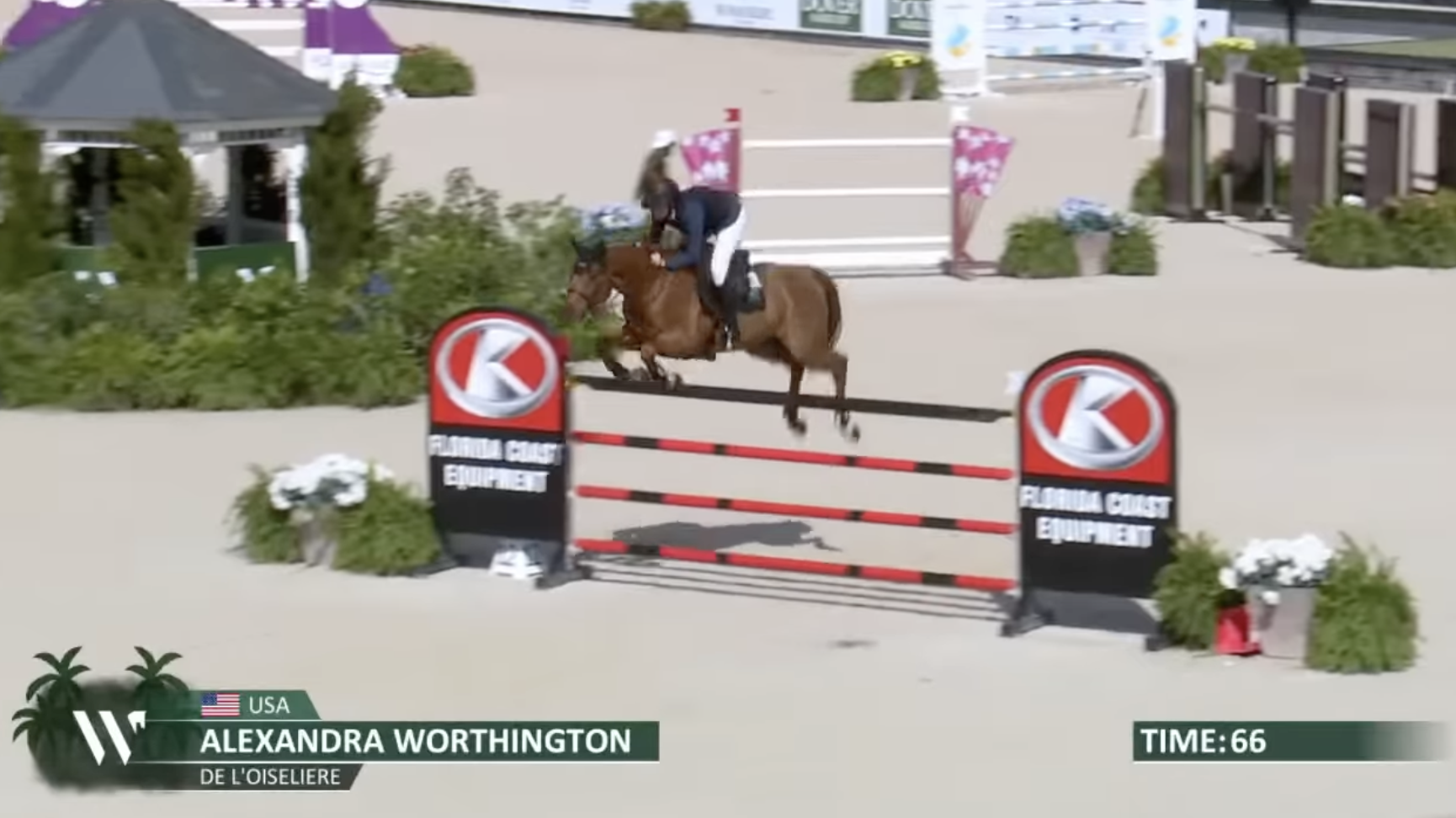
If you want to practice watching a Show Jumping class, now that you have some background info, you can watch this video here to watch a high level Grand Prix event (a Jump Off Class!) with some helpful narration / commentary.
Bonus Content: Other Horse Sports
There are many “disciplines” (genres, kind of) in horse sports, they vary widely, and it’s honestly incredible how athletically diverse horses can be!
Here is a brief rundown of equestrian disciplines for context:
Racing - Running around a track as fast as possible, head to head. Very popular, not Olympics sport.
Steeplechase- Same as racing, but with obstacles to jump over on the track
Endurance - Long-distance horse racing, head to head, can be up to 100 miles in a day.
Dressage- Modern dance for horses, it’s judged similarly to how floor gymnastics is judged. This is an Olympic sport!
Show Jumping - Horses compete one at a time in a race to jump over a set course of large obstacles as fast as possible without knocking any obstacles down (the obstacles are easy to knock down). This is an Olympic sport!
Eventing- Horse triathlon, basically. The horses compete in Dressage, basically a form of steeplechase, and show jumping all over the course of 3 days. This is an Olympic sport!
Polo: Two teams consisting of 5 horse/rider combinations try to hit a ball into the opposing team’s “goal” using a long mallet to hit the ball.
Reigning - Western style riding involving running fast and stopping short and turning extremely fast. I don’t know a lot about this but it’s cool and impressive!
There are many many more, but these are the big ones you might see / hear about most commonly. Theres a lot of depth in the western disciplines, which I know nothing about -but, I hope to learn more about!
Congrats on finishing the second installment of Horse World 101 !