
What Actually Goes Into Horse Showing:
Traveling to and from horse shows is a borderline heroic feat every single time. We take for granted how complicated it actually is to bring horses to competitions, but it’s essentially like bringing a band on tour… with a band made up of 1,200 lb wild animals and the lead singer of the band is also the manager, sound engineer, the accountant, and one of the roadies.
Going to a horse show sounds placid, but wrangling up animals and equipment and transporting everything is more like a military operation.
Advance notes:
This article describes going to an “away” show, where you stay at the competition venue for multiple days. There are also one-day horse shows where you arrive in the trailer, compete, and go home in the same day without ever needing stabling at the show, but that’s not the topic here.
I’m writing from my own personal experience- many riders have larger operations than me and are also responsible for organizing their clients’ horses and arrangements, and even have managers to help keep all of the proverbial ducks in a row, which gets much more complicated.
Preparing for a Horse Show:
Training
Leading up to an event, as a rider/trainer, it’s your job to make sure the horses are prepared mentally and physically, so they need to be training to be brave, fit, relaxed, and locked in. This is managed daily leading up to the competition. Every horse should have a unique training regimen based on their strengths, weaknesses, experience, health, and the level they are competing at. The training program must account for both the horse and the rider’s personal biases. You want to strengthen weaknesses, desensitize sensitivities, and prepare for the changes in behavior at the competition venues. You may also adjust a horse’s feed / supplement plan leading up to competition, and many medications and /or treatments must be stopped in advance of competing.
Entering The Show
A rider must formally enter the horse show, which means submitting Entries to the competition venues, usually about a month in advance of the actual event (although in my case it is often at the last second). The entry forms include the horses’ and rider’s identifying information and federation numbers (USEF aka United States Equestrian Federation and/or FEI aka Fédération Équestre Internationale), as well as the SSN or EIN of the recipient of any prize money.
Transportation
You need to arrange transportation for the horses to the completion. For me that usually means I drive the trailer full of my horses and equipment. For many others it involves arranging a driver for your trailer or hiring a shipping company to pick up/drop off the horses and equipment, which can unsurprisingly be challenging to schedule.
Transportation for your staff and yourself must be accounted for as well. If everyone is driving their own vehicles, that’s easiest. If anyone needs to fly, then you have to arrange airport drop-offs, flights, and rental cars upon arrival.
Supplies
Feed, bedding (straw or shavings), and hay needed during the competition must be ordered to your stables at the horse show in advance of your arrival, unless you’re bringing it yourself, in which case it must be loaded and unloaded from the trailer.
You must bring everything else you need from home, including your tack, blankets, brushes and bathing supplies, buckets, boots, bandages, freezer/ice boots, hay steamer, fans, therapies, wheelbarrow, towels, grain, any training gear etc. Most of this will be packed into large plastic trunks and/or into a large rolling locker and could easily fill a sprinter van or two.
You’ll need your paperwork in order as well!
Paperwork To Enter a Competition Venue:
Vaccine Statement - a document from a veterinarian proving when each horse was last vaccinated (must be within the last 6 months).
Coggins - an official certificate signed by a veterinarian proving that your horse has tested negative for Equine Infectious Anemia in the last 12 months.
Health Certificate (CVI) - if you’re crossing state borders to get to a competition, this document is required by the state detailing where a horse is leaving from and where they are going to, and when.
Statement of Health - some shows require a separate form that is a specific statement of health from a veterinarian saying that a horse is healthy to their knowledge.
If you’re entering international level competition (FEI), you must complete a digital self-certification form and record your horse’s temperature 2x daily from three days before the show though the end of the show.
Arriving at a Horse Show:
Unloading / Set Up
Before or upon arrival, you have to find a stall chart to learn where your assigned stabling is.
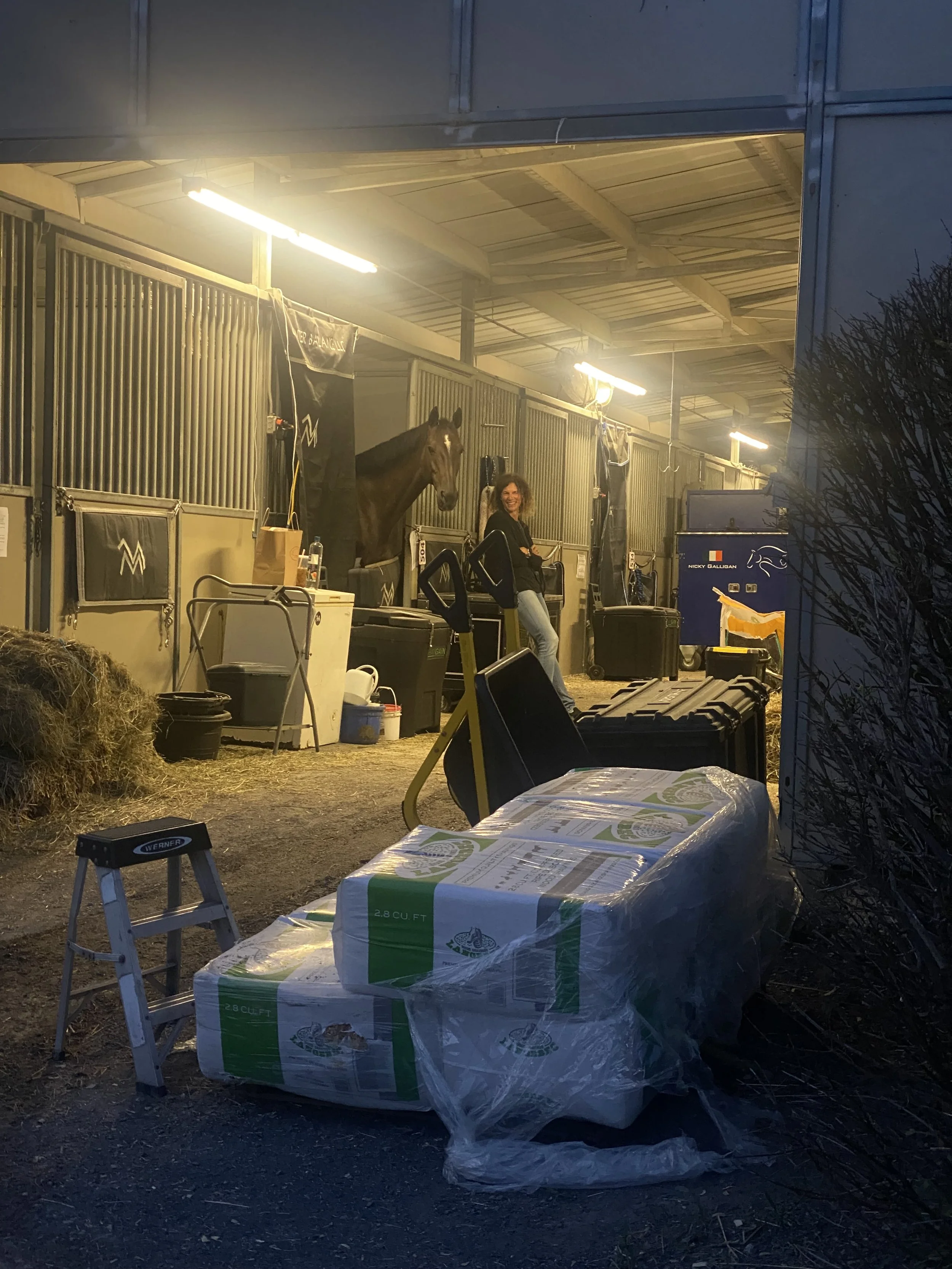
Upon arrival at the stalls, you/your team must unload your horses and equipment and set up your stabling. You’re assigned one stall per horse, and you can use the free space a few feet on either side of the stall doors to unpack all the gear. This means arranging all of the trunks of equipment you packed off of the trailer and arranging it all in your aisle at the show to be functional in the same way your barn at home is. Normally it’s close quarters, so you must be efficient with the space so that horses can pass through the aisles freely and you’re not encroaching on your neighbor’s space.
Stalls must be bedded, water and feed buckets hung for the horses, fans mounted in the stalls if it’s warm, blankets hung, stall guards and banners hung, freezer plugged in, and loose extension cords tied up and hidden. This all requires a lot of zip ties and baling twine!
Big shout out here to the grooms who make this all look effortless. This is a lot of cumbersome handwork and requires a lot of forethought and organization, and the pros make it seem quick and easy, which always blows my mind!
Show Office
Before you can compete, you must go to the show office to present the aforementioned paperwork. If everything is in order, you will receive your competition numbers and be able to enter the specific classes you want to jump that week. If you change your plans and adjust your schedule / which classes you want to jump during the week, you must go back to the show office to formalize the change.
The Horse Care:
Being at a competition means adapting your horses’ regular “home” routine to being in a new place. Similarly to if you move yourself into a hotel for a week, you have to adapt your routines a bit. Some things may take longer than usual. For example, filling up water buckets by carrying them to a spigot rather than having built-in hoses in each individual stall may add minutes to the morning routine. Without access to paddocks or a hot-walker/treadmill at shows, it may require riders / grooms to hand walk, graze, or longe horses at shows that would never require it at home.
You try to do your best to keep your horses’ routine and schedule as “regular” as normal so they don’t be come stressed, exhausted, or too energetic. The horses may have to be worked multiple times per day to stay relaxed and loose, while others may be conserving energy throughout the week.
To try and keep the horses feeling their best so they perform their best, we use holistic therapies including magnetic blankets, therapeutic ultrasound / lasers, massage/acupuncture, cryotherapy, bandages, and herbal supplements at competitions.
Day of Competition:
The Plan:
The night before you compete, the horse show will post the schedule for the next day online. This will inform you of when your classes will start and when you go in the order for those classes, so you can plan for what time you’ll compete. You’ll also plan what time your horses should eat during the day, when and how you will warm up your horses, when you walk the courses, and what time you’ll be mounted for competition.
Calculating the time you will jump is based on knowing what time the class will start, and then calculating how many horses will jump ahead of you and guessing how long each of them will take. If it’s a speed class vs a jump off class, for example, you’d estimate a different amount of time that each of the horses ahead of you will take (speed round being approx 2 min per horse and a jump-off class I would estimate approximately 3 min per horse, expecting it to vary based on the severity of the class.) You will also account for the “pauses” in competition for footing maintenance (approx 10 min breaks after approx every 30 horses jumps.)
For example, if your class starts at 9:00 am and you go 50th in the order and it’s a speed class, you’ll end up competing around 10:50 am. You estimate 2 minutes for each horse ahead of you (100 minutes) plus a 10 minute arena maintenance break after the 30th competitor, which puts you around 110 minutes after 9:00 am to be competing.
Once you know what time you’ll be in the ring, you can plan what time to get on your horse to warm up (normally 20 min ahead of when you will compete, +/-). And you can also plan if the horse will get out earlier in the day for a stretch or additional training, and any other therapies or pre-competition rituals that horse requires.
Then you repeat this process for every horse you have competing and/or your clients have competing in the same day, making sure the schedules align so that everything gets done and multiple horses aren’t competing at the same time. (This may require asking the managers of the competing rings to shuffle around your start times, which can be a great feat in itself.)
Lastly, once you find out how to make it all work, you have to communicate the schedule to your staff and clients to make sure everyone knows where to be at what time, and then hope it all works out!
One notable point to remember is that at horse shows, despite the best laid plans, it’s safe to assume the timing you anticipate the day before will be amiss in one way or another, so it’s important that everyone involved stay flexible and communicative throughout!
Actually Competing
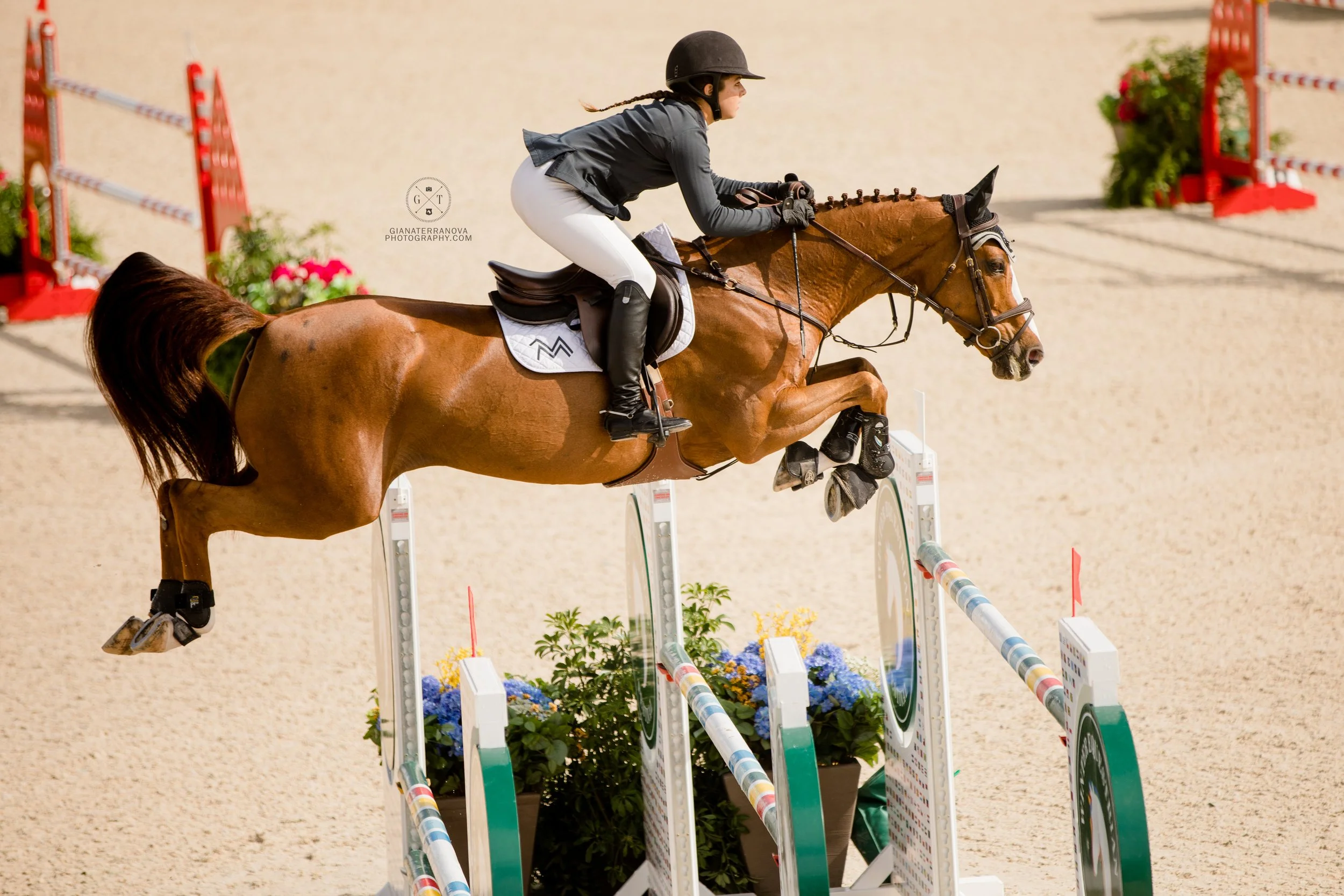
All of this planning, transporting, training, caring (not to mention the money spent) amounts to the actual competition, which is normally approx. a 75-second trip in the ring. Most horses jump 2-4 classes per week depending on their discipline, so you’re looking at maybe 5 minutes total of showing for a typical horse. Even the coolest rider in the world can’t help but feel the pressure of all of the work that goes into a couple of minutes in the show ring - it’s staggering if you really think about it.
Whether you like it or not, all sports are a form of professional gambling. Anything can happen in the blink of an eye to change the fate of any athletic trial. Equestrian sport in particular has the greatest number of “x factors,” as we are not only dealing with the unpredictability of human athletes and all of the things that can affect them, but also the unpredictability of horses who are enigmatic to say the least.
Horse showing almost shouldn’t be possible; it’s very complicated and requires a lot of flexibility and trust from both humans and horses. When you have a bad day, it’s devastating because it takes so much to even show up. It can take a lot of strength to stay grounded and motivated when the losses hit hard. But… when it all pays off and you have a great show, it’s truly the best feeling in the world. Horse showing at all is heroic, and winning is elating!
Leaving a Horse Show:
Packing up and leaving is a bit easier than arriving. Packing up generally takes less time than moving in. The show set-up is temporary by design, so it’s not too complicated to tear it all down, cut down the zip-ties, untie the knots, and wheel all the gear out and and chuck it back into the trailer. The tricky part is once you get all the way back home and unload your horses and gear back into the barn. Everything must be unpacked again, cleaned, laundered, reorganized, and put away attentively so that it’s all ready to go next time you’re packing to leave again!